W. T. Stead: The Fearless Editor Who Transformed Modern Journalism
A Visionary Reformer, Courageous Campaigner, and the Man Who Changed the Power of the Press Forever

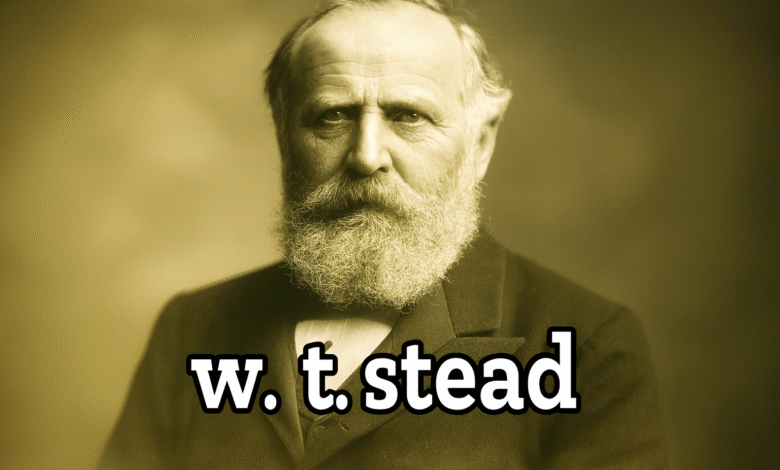
Table of Contents
ToggleIntroduction
William Thomas Stead, known globally as W. T. Stead, was more than just an editor — he was a force that reshaped the boundaries of journalism. His name stands tall among the greatest reformers of Victorian Britain. As an editor, writer, and social crusader, Stead’s work changed how newspapers influenced politics, society, and morality.
He was bold, outspoken, and controversial. His fearless investigative style inspired admiration and outrage in equal measure. While his campaigns sparked major social reforms, his daring methods also drew criticism. Yet, one thing is certain — Stead was a pioneer who dared to speak truth to power.
Quick Bio of W. T. Stead
| Fact | Details |
|---|---|
| Full Name | William Thomas Stead |
| Born | 5 July 1849 |
| Birthplace | Embleton, Northumberland, England |
| Died | 15 April 1912 (RMS Titanic) |
| Nationality | British |
| Occupation | Journalist, Editor, Publisher |
| Religion | Congregationalist Christian |
| Spouse | Emma Lucy Wilson |
| Children | Six |
| Known For | Founding the “New Journalism” movement, social reform campaigns, and fearless editorial style |
Early Life and Education
W. T. Stead was born in Embleton, Northumberland, in 1849, into a deeply religious family. His father, Reverend William Stead, was a Congregational minister whose moral discipline and faith strongly shaped his son’s worldview. From an early age, Stead was immersed in education — his father taught him Scripture, Latin, and moral values that would later influence his editorial philosophy.
He continued his education at Silcoates School in Wakefield, a nonconformist institution known for its focus on independent thought and Christian values. After completing school, he began working as an apprentice in a merchant’s office in Newcastle upon Tyne. These early years taught him diligence, discipline, and the struggles of ordinary working-class people — experiences that became the foundation of his future editorial voice.
The Start of a Revolutionary Career
Stead’s career began humbly but grew rapidly. In 1870, he started writing for the Northern Echo, a liberal newspaper in Darlington. His natural flair for persuasive writing and passion for justice quickly made him stand out. At just 22 years old, he became the Editor of the Northern Echo, making him one of the youngest editors in Britain.
As editor, Stead turned the Echo into a national voice for reform. He campaigned against injustice, poverty, and government negligence. His bold leadership transformed the regional paper into a publication of national importance, gaining attention from prominent politicians and thinkers of his time.
The Pall Mall Gazette and the Birth of “New Journalism”
In 1880, Stead moved to London to join the Pall Mall Gazette as assistant editor. Within three years, he became its Editor, marking the beginning of one of the most influential periods in British journalism. Under his leadership, the newspaper became a powerful platform for social change.
Stead pioneered what became known as “New Journalism” — a dynamic, emotional, and visual form of reporting that blended fact, passion, and persuasion. He introduced interviews, illustrations, maps, and human-interest stories, making news more accessible to ordinary readers. His aim was not just to inform, but to move people to action.
The Maiden Tribute of Modern Babylon – A Historic Campaign
In 1885, Stead published his most famous — and most controversial — investigation, The Maiden Tribute of Modern Babylon. This shocking series exposed child exploitation and the dark underworld of London’s sex trade. His reports were vivid, emotional, and brutally honest.
The campaign caused public uproar but achieved historic reform. It led directly to the passing of the Criminal Law Amendment Act of 1885, which raised the age of consent from 13 to 16 in Britain. Although Stead was later imprisoned for his methods, his courage proved that journalism could be a tool for justice.
Founder and Editor of the Review of Reviews
In 1890, Stead launched his own publication — the Review of Reviews — an international journal summarizing global news and ideas. As its Editor, he combined intellectual depth with accessibility, helping readers understand world affairs.
The Review of Reviews expanded Stead’s influence beyond Britain. It became a respected voice for peace, education, and reform. He used his platform to promote the idea of “government by journalism”, believing that the press could guide public morality and political decision-making.
Beliefs, Spiritualism, and Later Years
Stead’s deep moral convictions extended into spiritualism later in life. He became fascinated by the idea of life after death and published works on psychic experiences and spirituality. While controversial, these interests showed his fearless curiosity and openness to new ideas.
In 1912, Stead was invited to attend a peace conference in the United States. He boarded the RMS Titanic for his journey — but tragically perished when the ship sank. Witnesses reported his calm and selfless actions, helping others reach lifeboats before the end.
Legacy and Impact on Journalism
W. T. Stead’s legacy is monumental. He transformed journalism from simple news reporting into a powerful tool for social reform. His innovations — emotional storytelling, interviews, and human-interest narratives — are still core elements of modern journalism.
As an editor, Stead believed newspapers should not merely report events but shape society. He demonstrated how courage and conviction could turn journalism into a moral crusade. His work laid the foundation for investigative journalism and inspired future generations of reporters worldwide.
Stead’s life reflected both positive and negative sides of journalistic power — his bravery brought reform, but his sensationalism raised ethical questions. Yet his influence remains undeniable: he taught the world that words can change laws, hearts, and history.
Conclusion
W. T. Stead was a fearless editor, a reformer, and a visionary. He lived a life of purpose, courage, and controversy, using his pen as a weapon for justice. His story reminds us that journalism is not just about headlines — it’s about truth, empathy, and impact.
Even a century after his death, Stead’s voice still echoes through the principles of modern media. He proved that when guided by conscience, the written word can change the world. His legacy endures as one of the most powerful examples of journalism’s potential to challenge and transform society.
Frequently Asked Questions (FAQ)
1. Who was W. T. Stead?
W. T. Stead was a British journalist and editor known as the father of “New Journalism.” He used the press to advocate for social reforms and moral causes.
2. What was his most famous work?
His most famous campaign was The Maiden Tribute of Modern Babylon (1885), which exposed child exploitation and helped reform British law.
3. What publications did he edit?
He served as Editor of The Northern Echo and The Pall Mall Gazette and later founded the Review of Reviews.
4. How did W. T. Stead die?
He died aboard the RMS Titanic on April 15, 1912, while traveling to the U.S. for a peace conference.
5. Why is W. T. Stead important in journalism?
He revolutionized journalism by introducing investigative reporting, human-interest storytelling, and using newspapers as tools for reform.