Nesrine Malik – The Fearless Sudanese Journalist and Author Redefining Truth and Power
How Nesrine Malik’s powerful voice challenges myths, shapes discourse, and inspires change in modern journalism.

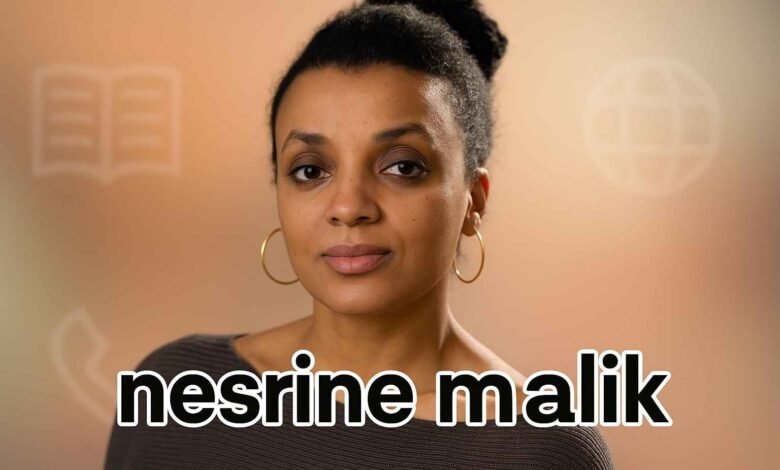
Table of Contents
ToggleIntroduction
Nesrine Malik is a celebrated Sudanese journalist and author, best known for her fearless commentary and thought-provoking writing. She has emerged as one of the most influential voices in British media, challenging political narratives, cultural myths, and societal biases with courage and intellectual depth. Her writing blends personal experience with sharp political insight, offering readers a clear-eyed view of how power and privilege operate in today’s world.
Born in Khartoum, Sudan, and raised across several countries, Malik brings a global and multicultural perspective to her work. As a columnist for The Guardian, her journalism explores identity, race, freedom, and inequality with boldness and integrity. Her contributions have not only reshaped modern discourse but also inspired a new generation of writers and thinkers who value truth over convenience.
Quick Bio
| Full Name | Nesrine Malik |
|---|---|
| Profession | Journalist, Author, Political Commentator |
| Nationality | British-Sudanese |
| Birthplace | Khartoum, Sudan |
| Education | American University in Cairo, University of Khartoum, University of London |
| Known For | The Guardian columns, We Need New Stories (2019) |
| Major Themes | Identity, Race, Politics, Media Narratives, Islamophobia |
| Current Residence | London, United Kingdom |
Early Life and Education
Nesrine Malik’s story begins in Sudan, where she was born and spent part of her early childhood before moving to Kenya, Egypt, and Saudi Arabia. This multicultural upbringing exposed her to diverse political and social systems, shaping her worldview and igniting her interest in global affairs. Her cross-continental experiences gave her a deep understanding of migration, inequality, and the challenges faced by people living between cultures.
She studied at the American University in Cairo and the University of Khartoum, before pursuing further education at the University of London. Her academic journey equipped her with a strong foundation in political science and communication, later influencing her analytical and narrative-driven approach to journalism.
Professional Journey
From Finance to Journalism
Before she made her mark as a writer, Nesrine Malik spent nearly a decade working in private equity within emerging markets. This professional background gave her valuable insights into the global economy, governance, and corporate influence — knowledge that would later enrich her journalistic perspective.
Her transition from finance to journalism marked a bold step into storytelling and advocacy. She began writing on issues that resonated deeply with her — race, gender, media bias, and the politics of belonging — establishing herself as a voice of truth and critical thought.
Career with The Guardian
Malik became a columnist and feature writer for The Guardian, where she continues to deliver some of the most incisive commentary in modern journalism. Her work addresses subjects such as immigration, Islamophobia, freedom of speech, and identity politics, offering nuanced reflections that go beyond conventional narratives.
She does not shy away from controversy; rather, she embraces it as a tool to spark meaningful dialogue. Her opinion pieces regularly challenge readers to rethink their assumptions and question the myths that dominate public life. Through her fearless writing, Malik has redefined how readers engage with complex global issues.
Publications and Literary Impact
In 2019, Malik published her groundbreaking book, We Need New Stories: Challenging the Toxic Myths Behind Our Age of Discontent. The book examines the powerful myths that dominate Western society—about free speech, identity, and national pride—and exposes how these myths protect privilege and hinder progress.
The book was widely acclaimed for its depth and originality. Critics praised Malik’s ability to combine scholarly analysis with passionate storytelling, making difficult ideas accessible to a broad audience. Her work resonated with readers seeking clarity in an age of political division and media distortion. The book remains a key reference for anyone interested in understanding how narratives shape modern democracy.
Awards and Recognition
Nesrine Malik’s work has earned her numerous honors for its courage and insight.
In 2017, she won the Society & Diversity Commentator of the Year award at the Comment Awards.
In 2019, her reporting on Britain’s immigration policies was longlisted for the Orwell Prize for Exposing Britain’s Social Evils.
In 2021, she received the Robert B. Silvers Prize for Journalism, celebrating her excellence in thought and prose.
She was also elected a Fellow of the Royal Society of Literature in 2023, an acknowledgment of her lasting contribution to British letters.
In 2024, she was shortlisted for the European Press Prize for her essay “All That We Had is Gone: My Lament for War-Torn Khartoum.”
These recognitions demonstrate her commitment to truth, justice, and literary integrity. Her achievements reflect not only personal success but also a growing demand for honest journalism in a polarized world.
Recent Focus and Themes
In her recent work, Malik continues to analyze pressing global issues with moral clarity and depth. She has written movingly about the Sudan conflict, connecting the personal loss of her homeland to the broader struggle for freedom and peace. Her writings on British and American politics explore the erosion of democratic values, the manipulation of media narratives, and the weaponization of identity.
Through her journalism, Malik stands at the intersection of empathy and intellect. She represents a new generation of journalists who blend emotional truth with factual precision, proving that storytelling can be both compassionate and uncompromising.
Legacy and Influence
Nesrine Malik’s legacy extends far beyond her articles and books. She has redefined what it means to be a journalist in the 21st century — one who speaks truth to power without fear or compromise. Her work challenges injustice and inspires critical thinking in readers worldwide.
As a Sudanese journalist and author, she symbolizes resilience, intellect, and courage. Her journey from Khartoum to London illustrates the power of words to transcend borders and bridge divided worlds. Malik’s influence continues to grow, as she inspires writers, activists, and readers to confront uncomfortable truths and imagine a fairer world.
Conclusion
Nesrine Malik’s life and work embody the strength of conviction and the pursuit of truth. Her writing pierces through propaganda and prejudice, guiding readers toward clarity and empathy. In a world flooded with noise, she remains a beacon of reason, integrity, and fearless thought.
Her story reminds us that journalism is not just about reporting facts—it is about redefining reality, reclaiming truth, and restoring humanity to the global conversation.
FAQs
Q1: Who is Nesrine Malik?
Nesrine Malik is a British-Sudanese journalist, author, and commentator known for her work with The Guardian and her book We Need New Stories.
Q2: What is Nesrine Malik’s nationality?
She is of Sudanese origin and currently based in the United Kingdom, identifying as British-Sudanese.
Q3: What is her book We Need New Stories about?
The book explores how cultural and political myths distort public understanding of freedom, identity, and democracy.
Q4: What are Nesrine Malik’s main areas of focus?
Her work focuses on race, identity, politics, media, Islamophobia, and power dynamics in society.
Q5: Why is Nesrine Malik influential?
She is recognized for her fearless writing, intellectual integrity, and for redefining how journalism addresses issues of identity and justice.